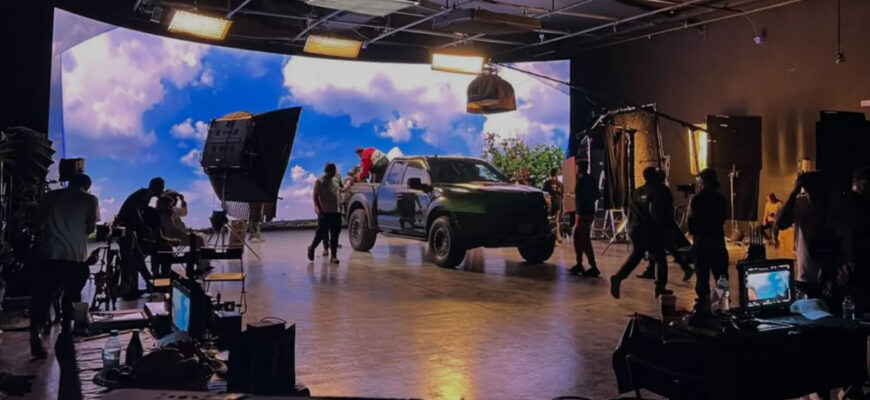
Led wall virtual production is changing the way commercial film teams plan, shoot, and review visual content. In a traditional green screen workflow, directors, cinematographers, actors, and clients often need to imagine the final background while looking at a flat colored surface. That gap can create uncertainty on set. Lighting may look acceptable during the shoot but feel unnatural after compositing. Reflections on products or vehicles may not match the digital environment. Actors may struggle to react to a place they cannot see. An LED wall brings the environment into the studio, so the crew can judge composition, color, movement, and atmosphere while the camera is rolling.
For advertising and brand content, this matters because production schedules are often tight. A campaign may need a city night scene, a luxury showroom, a futuristic product launch, and a lifestyle interior within the same week. With LED wall virtual production, those environments can be prepared digitally and switched quickly, reducing the need for repeated location moves. The physical set still matters, but it becomes a focused foreground build instead of a complete location replica. This approach gives creative teams more control and gives clients a clearer preview of the final image during production.
Another advantage is lighting realism. A green screen does not emit the colors of the world that will be added later. An LED wall does. If the background is a warm sunset, the wall can cast warm light onto the actor and props. If the scene is a cold city street, the wall can contribute blue and neutral tones. This interactive lighting helps cameras capture a more believable result in-camera, especially when shooting reflective surfaces such as cars, glass packaging, jewelry, electronics, or glossy furniture.
Teams exploring this workflow should start with the broader production system, not only the screen. The led wall virtual production solution from Esdlumen shows how LED displays, xR stages, broadcast studios, live events, and virtual shooting environments can be treated as connected use cases. That is a useful way to think about the investment: the wall is not just a background, but a real-time visual platform that supports camera, lighting, content, and control systems.
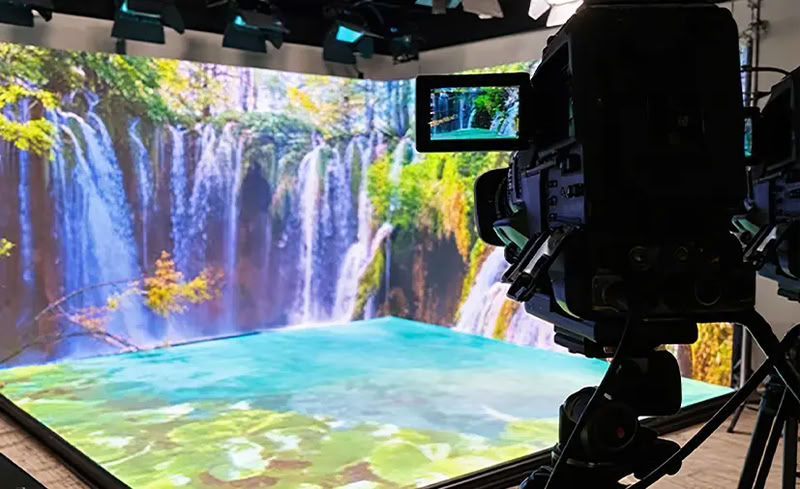
Screen quality still remains essential. Commercial work often involves close shots, brand colors, product details, and demanding client approvals. A panel with suitable pixel pitch, high refresh rate, accurate color reproduction, and reliable cabinet alignment will reduce visible artifacts and save time during testing. For projects that require fast installation, creative staging, and high-end indoor rental performance, a product such as the Pilot Pro fine pitch rental LED display can be considered as part of a flexible studio or temporary production setup.
The best results come when the virtual production plan is built early. The director should know which backgrounds will be captured in-camera and which elements will still be finished in post. The cinematographer should test focal lengths, shutter settings, and camera distance against the LED wall. The art department should decide what physical foreground pieces are needed to sell the illusion. The content team should optimize scenes for the wall size and camera movement, not only for a computer monitor.
It is also important to set client expectations. LED wall production can reduce certain post-production tasks, but it does not remove the need for preparation. A campaign still needs storyboards, previsualization, art direction, color references, and a practical shooting plan. The difference is that more decisions can be tested before the shoot and corrected during the shoot. If a background is too bright, the team can adjust it. If a reflection is distracting, the content can be modified. If a product color looks inaccurate, the color pipeline can be checked immediately. This makes the production day more collaborative and less dependent on after-the-fact rescue work.
The workflow can also help agencies create more content from one production day. Once the wall, lighting, and foreground set are prepared, the same talent can be filmed in several brand environments without rebuilding the entire stage. A hero commercial, social clips, product explainers, behind-the-scenes footage, and sales presentation material can all come from the same controlled setup. That makes the value of the LED wall easier to justify for brands that need many deliverables across channels.
For commercial teams, the key benefit is not simply novelty. Led wall virtual production helps reduce guesswork, shorten feedback loops, and make the set a place where creative decisions can happen with the final image in view. When used with careful planning, it can turn a studio into many locations, improve collaboration between departments, and give brands a more controlled path from concept to finished campaign.